
Find a Florida Inmate, Facility, Release Record or Supervision Status
A Florida inmate search starts with one practical question: which agency currently has custody? Someone arrested yesterday is usually in a county jail, while a person serving a Florida state-prison sentence appears in the FDOC Offender Search. Federal custody and immigration detention use separate systems.
This homepage explains that choice first and then shows exactly how to search, verify a record, understand a DC number, locate a facility, send funds through Correct Pay, prepare for visitation, check release or supervision information and report urgent safety or staff-misconduct concerns. Both existing FDOC search screenshots from this website are retained in the search section.
FDOC and county-jail databases are public-information tools, but they are not substitutes for a certified court record, legal advice or direct confirmation from the holding facility. An arrest does not prove guilt, and an older correctional record may not describe the person’s present legal status.
Do not use this page or an FDOC result as a consumer report for employment, housing, credit, insurance or another decision regulated by the Fair Credit Reporting Act. Confirm identity before assuming that a record belongs to a particular person.
Which Florida Inmate Search Should You Use?
| Situation | Correct system | Useful identifiers | Typical result |
|---|---|---|---|
| Recent county arrest | County sheriff or county corrections jail search | Name, birth date, booking number, arrest county | Booking, bond, charges, court date and current jail where published |
| Florida state-prison sentence | FDOC Inmate Population Search | DC number or name with identity filters | Facility, sentence, release information and photograph where available |
| Released from state prison | FDOC Inmate Release Search | DC number or name | Release information and prior state-custody record |
| Probation or community supervision | FDOC Supervised Population Search | DC number or name | Supervision status and office details where published |
| Federal case or sentence | Federal Bureau of Prisons locator | Name or federal register number | Federal institution and projected release information |
| Immigration detention | ICE Online Detainee Locator | A-number and country of birth, or exact biographical data | ICE detention information when publicly available |
FDOC is not the first place to search immediately after a local arrest. The person normally remains in the arresting county’s jail system unless and until a court sentence and transfer place them in Florida state-prison custody.
Florida Department of Corrections Inmate Search: Exact Steps
- Open the official Offender Search Confirm that the page uses the Florida government domain. The search is free and no subscription is required.
- Choose “Search All Corrections Offender Databases” when custody is uncertain This searches common fields across inmate population, release, supervision, absconder or fugitive and escape data.
- Use the DC number whenever available A DC number is more precise than a name. Otherwise enter the name carefully and add birth date, race, sex or other filters only when known.
- Open the possible match Compare the DC number, birth date, photograph, physical description, facility, offense and sentence information.
- Save the confirmed DC number and current facility These details are needed for future searches, facility contact, funds, mail and visitation.
- Verify urgent or time-sensitive information Call the facility or appropriate FDOC unit before travelling, sending legal paperwork or relying on a release date.
DC number → exact last and first name → name plus birth date → broader name spelling → county jail search → federal or ICE search where appropriate.
Recognise the Official FDOC Search Screens
These are the two existing screenshots already used on this homepage. They remain here because they help readers identify the correct menu and avoid imitation people-search pages.
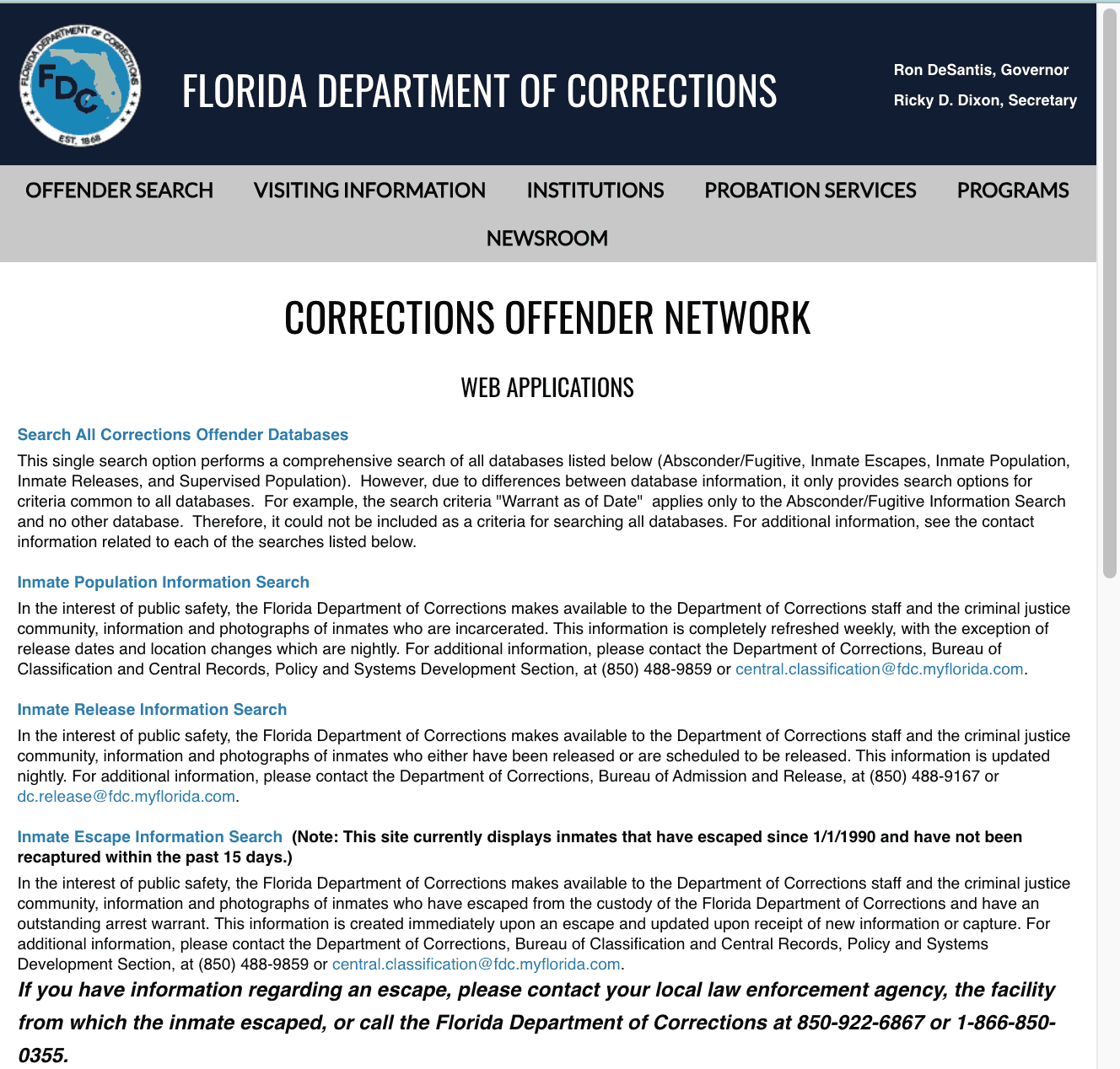
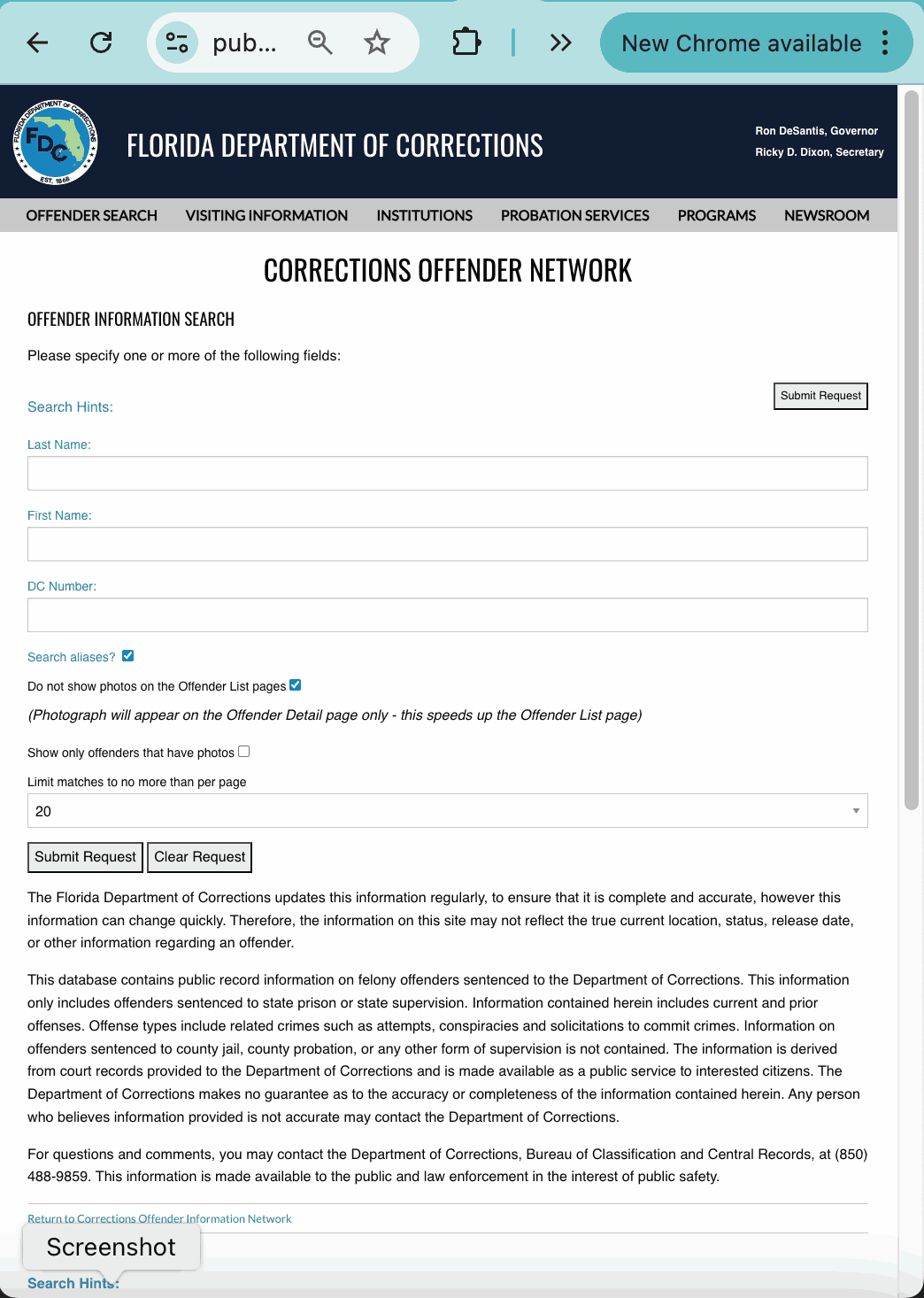
What Each FDOC Offender Database Means
| Database | Use it for | Official update pattern |
|---|---|---|
| Inmate Population | People currently in Florida state-prison custody | Full data refreshed weekly; release dates and location changes updated nightly |
| Inmate Release | People released from Florida state custody | Updated nightly |
| Supervised Population | Probation, community control and other FDOC supervision | Full data weekly; termination dates and locations nightly |
| Absconder/Fugitive | People alleged to have left supervision without authorization | Use the displayed record and report information to FDOC or law enforcement |
| Inmate Escape | Escape records and public-safety information | Report sightings to 850-922-6867 or 1-866-850-0355; do not approach |
Different fields follow different update schedules. A facility move or release-date change may appear before a full weekly data refresh, while a county booking never appears in FDOC merely because the arrest happened in Florida.
How to Read an FDOC Inmate Record Correctly
DC number
The Department of Corrections identifier. Use it as the primary reference for searches, deposits and facility communication.
Current facility
The institution shown in the public record. Transfers can occur, so verify shortly before travel or time-sensitive mail.
Release information
A projected or scheduled date is not an unconditional promise. Credits, detainers, court action and administrative changes may affect it.
Offense and sentence
A correctional summary, not the full court file. Use the county clerk for pleadings, orders, docket entries and certified records.
Photograph
Useful for identity confirmation but may be older than the current appearance and should not replace other identifiers.
Prior or released record
A person can remain searchable after release. Read the custody or supervision field before describing them as currently incarcerated.
Why You Cannot Find Someone in the Florida DOC Search
The arrest is too recent
Search the arresting county’s sheriff or corrections website. FDOC is a state-prison and community-supervision system, not Florida’s statewide county booking database.
The name is stored differently
Try a legal surname, former surname, hyphenated spelling, middle-name variation or fewer filters. Avoid guessing a birth date or race because a wrong filter can hide a valid result.
The person is federal or in immigration custody
Use the Federal Bureau of Prisons or ICE locator. State, federal, county and immigration custody systems do not share one universal search.
The person is supervised rather than incarcerated
Use the Supervised Population database for probation, community control or related supervision information.
A transfer or release is still processing
Check again after the relevant update cycle and contact classification or release staff when the matter is urgent.
Florida County Jail Search for a Recent Arrest
- Identify the arrest county Use the city, arresting agency, police report or court location.
- Open that county sheriff or corrections website Look for “Inmate Search,” “Jail View,” “Arrest Search,” “Corrections” or “Who Is in Jail.”
- Search by name or booking number Use date of birth to distinguish similar names.
- Review booking and bond fields carefully A charge may be an allegation, and a bond amount does not prove that release has occurred.
- Verify directly before travel or payment County release, transfer, bond and visiting information can change faster than the public page.
Facility Assignment, Reception and Transfers
County custody
After arrest and during many court proceedings, the person generally remains under the county system.
Reception and classification
After an eligible state-prison sentence, FDOC receives, evaluates and classifies the person before a longer-term assignment.
Institution assignment
Placement can consider security, medical and program needs, sentence factors, bed space and other operational requirements.
Do not mail time-sensitive documents, travel for a visit or send funds using an unverified location. Confirm the current facility and DC number first.
How to Send Money to a Florida State Prison Inmate
Correct Pay replaced JPay as FDC’s inmate-funds provider on 1 May 2024. Older Florida deposit instructions that still direct families to JPay are outdated.
Who can send funds?
FDC normally requires the sender to have current approved visitor status in the inmate’s automated visiting record. For a newly received inmate, FDC allows a limited exception for up to 60 days after reception or until the visiting record is established, whichever happens first.
| Method | Maximum | Fee or timing | Required information |
|---|---|---|---|
| Online, app or telephone | $300 per deposit | $0–29.99: $3.90; $30–74.99: $7.90; $75–149.99: $9.90; $150–300: $11.90 | Correct agency and inmate, DC number, card and sender details |
| Money order | $999.99 | FDC $0.50 processing fee; allow up to 10 business days | Payable to Correct Pay, deposit slip and valid sender-ID copy |
| Cashier’s check or certified bank draft | $3,000 | FDC $0.50 processing fee; allow up to 10 business days | Payable to Correct Pay, deposit slip and valid sender-ID copy |
Mailing address
FL DOC Inmate Deposits
PO Box 25900
Bradenton, FL 34206-5900
Personal checks are not accepted. Include the official deposit slip and a readable copy of a driver’s license, state ID or passport.
Before paying
Confirm the inmate’s DC number and that the location uses the FDC Correct Pay process. Private facilities, re-entry centres and county jails may use different procedures.
Correct Pay telephone deposits: 855-836-3364, available 24/7.
Florida State Prison Visitation: Practical Steps
- Confirm state custody and current institution County-jail and private-facility visitation rules are different.
- Complete the current FDOC approval process Provide accurate identity, relationship and background information. Do not assume approval until confirmation is received.
- Check the institution’s visiting schedule Schedules, eligible units, capacity and temporary restrictions can vary.
- Review identification and property rules Bring accepted photo identification and leave prohibited items outside the secure area.
- Call shortly before a long trip Lockdowns, transfers, medical isolation, weather or operational needs can cancel a visit.
- Arrive early and follow staff directions Screening, dress, conduct and physical-contact rules apply throughout the visit.
Processing depends on the application, background checks and institution. Wait for confirmation rather than travelling based on an estimated number of days.
Phone Calls, Electronic Messages and Personal Mail
Telephone calls
Florida state prisoners generally place outgoing calls through the institution’s approved system. They normally cannot receive an ordinary incoming personal call.
Electronic communication
Availability, approved contacts, message types and fees depend on the current FDOC communication system and institution. Confirm the inmate and facility before creating or funding an account.
Personal mail
Use the current official mail instructions, full committed name and DC number. Rules for photographs, cards, enclosures, publications and legal mail differ.
- Do not mail cash, personal checks, contraband or unauthorized items.
- Do not assume the institution’s street address is the correct personal-mail destination.
- Transfers can make an old mailing address unusable.
- Legal mail follows separate identification and handling rules.
Release, Transfer, Supervision and Escape Information
Victim and custody alerts
VINELink can provide custody notifications for participating agencies. Notification availability and timing depend on the reporting agency and enrollment.
Community supervision
Use the FDOC Supervised Population Search for probation, community control and related status. Full data is refreshed weekly, with location and termination changes nightly.
Escape or absconder information
Do not approach. Report escape information to 850-922-6867 or 1-866-850-0355, or contact law enforcement in an emergency.
A displayed date can be affected by sentence credits, detainers, court orders, warrants, disciplinary action and administrative recalculation. Contact FDOC Release Services at 850-488-9167 for an urgent record-specific question.
FDOC Record, Mugshot, Court Docket or Criminal History?
| Information needed | Best source | What it proves |
|---|---|---|
| Current Florida state custody | FDOC Offender Search | Correctional custody, facility and sentence summary |
| Recent arrest and booking | County sheriff or corrections site | Booking and jail information, not guilt |
| Court filings and disposition | County clerk of court | Docket, court orders and case disposition |
| Certified statewide criminal history | Florida Department of Law Enforcement process | Official criminal-history response under its rules |
| Correctional photograph | FDOC or county record where published | Identity aid, not proof of a current conviction |
Complaints, Emergency Reports, PREA and Public Integrity
| Problem | Correct route | Important action |
|---|---|---|
| Immediate threat, escape or urgent institution event | Institution, 911 where appropriate, or FDOC Emergency Action Center | Call 850-922-6867; do not wait for an online form |
| Physical abuse, excessive force, staff misconduct or criminal activity | FDOC Office of Inspector General complaint | Provide dates, location, names, witnesses and specific facts |
| Sexual abuse, sexual harassment or retaliation | PREA reporting and institution safety channels | FDC states zero tolerance; email PREA@fdc.myflorida.com for the PREA office |
| Fraud, waste or misuse | FDOC fraud, waste and misuse hotline | Call 866-246-4412 |
Inspector General scope
The official process covers allegations including physical abuse, excessive force, criminal activity, sexual misconduct, employee-caused death, whistleblower matters and other serious staff misconduct.
Complaint-form assistance: 850-488-9265.
Write a useful complaint
Separate what you personally observed from what someone else reported. Include institution, date, approximate time, staff or inmate names, witnesses, injury details and prior reports.
Keep a copy and confirmation number.
Florida Department of Corrections Headquarters
Central Office
501 South Calhoun Street
Tallahassee, Florida 32399-2500
Main published telephone: 850-488-7052
Visitation, inmate mail, funds, classification, release questions, supervision, complaints and public records have separate procedures. Use the correct unit rather than mailing sensitive documents to Central Office without instructions.
Important Florida Corrections Telephone Numbers
Inmate search and classification
850-488-9859Public inmate-search and classification-record questions.
Related Guides on This Website
FDOC visitation
Approval, scheduling, identification, clothing, travel and institution-verification guidance.
Read the visitation guide →Florida inmate population search
More detail about current FDOC inmate-population results and identity verification.
Read the population-search guide →FDOC mugshots
Understand correctional photographs, public availability and why a mugshot does not prove present custody or guilt.
Read the mugshot guide →Frequently Asked Questions
Is FloridaDepartmentOfCorrections.org the official FDOC website?
No. It is a privately operated independent guide. The official Florida Department of Corrections uses the fdc.myflorida.com domain.
Is the official Florida inmate search free?
Yes. The FDOC Offender Search is free and does not require a paid people-search membership.
Should I search FDOC immediately after an arrest?
Usually not. Search the sheriff or corrections database for the county where the arrest occurred. FDOC is used for Florida state-prison custody, releases and community supervision.
What does Search All Corrections Offender Databases include?
It searches common fields across inmate population, release, supervised population, absconder or fugitive and inmate-escape databases.
How often is the FDOC inmate database updated?
Full inmate-population data is refreshed weekly, while release dates and location changes are updated nightly. Other FDOC databases have their own schedules.
What is a DC number?
It is the Department of Corrections identifier displayed in FDOC records and is the most precise search field.
Why can I not find someone by name?
They may be in county, federal or immigration custody; the name may be stored differently; the person may be supervised rather than incarcerated; or a recent change may not yet appear.
Does an FDOC record contain the complete court case?
No. It contains correctional and sentence information. Use the county clerk for docket entries, pleadings, orders and certified case records.
Who is Florida’s state-prison money provider?
Correct Pay has been FDC’s inmate-funds provider since 1 May 2024.
Must I be an approved visitor to send money?
Normally yes. FDC provides a limited newly received inmate exception for up to 60 days or until the automated visiting record is established, whichever occurs first.
What is the maximum electronic Correct Pay deposit?
The current maximum online, app or telephone deposit is $300.
Where do I mail an FDC inmate money order?
Make it payable to Correct Pay and mail it with the official deposit slip and sender-ID copy to FL DOC Inmate Deposits, PO Box 25900, Bradenton, FL 34206-5900.
Can I visit without FDOC approval?
No. Complete the current approval process and wait for confirmation. Check the institution’s schedule and operational status before travelling.
Can a Florida state prisoner receive an incoming personal call?
Generally no. Incarcerated people place outgoing calls through the institution’s approved telephone system.
How do I report an urgent safety problem?
Contact the institution, 911 where appropriate, or the FDOC Emergency Action Center at 850-922-6867. Do not wait for an online complaint response.
How do I report staff misconduct or excessive force?
Use the Florida Department of Corrections Office of Inspector General complaint process. Form assistance is available at 850-488-9265.
Where is FDOC headquarters?
Central Office is at 501 South Calhoun Street, Tallahassee, Florida 32399-2500.
Research and Verification Method
This homepage was rebuilt after reviewing the live independent page, both of its existing FDOC search screenshots, the official Offender Search menus and update notes, FDC Correct Pay instructions, institution and visitation guidance, Inspector General complaint process, PREA information and published contact details.
Official links are kept mainly for final actions that cannot be completed here: running the live government search, making a deposit, completing visiting steps, checking a current institution, submitting a complaint, registering for alerts or contacting FDOC.