
Florida Prison Visitation Application, Approval and Entry Guide
A successful Florida prison visit begins long before the security gate. The visitor must use the current application, provide complete information, confirm approval, verify the incarcerated person’s facility and then arrive with clothing, identification and personal items that comply with current rules.
This guide explains that full process in plain English. It covers Form DC6-111A, minors, criminal-history questions, facility transfers, schedules, dress rules, permitted property, searches, contact conduct, non-contact and special visits, suspension issues and the practical checks that reduce the risk of a wasted trip.
This page is for people visiting someone in Florida Department of Corrections custody. County jails, federal prisons, juvenile facilities and immigration detention centres use different applications, schedules and property rules. Confirm the person is in FDC state custody before following this guide.
Start Here: The Seven Checks That Prevent Most Failed Trips
Confirm state custody
Use the official offender search to verify the DC number, current institution and custody status. Search information can change quickly, so confirm close to the visit date.
Use the current application
Complete the current DC6-111A form and follow the submission instructions associated with the incarcerated person’s institution.
Wait for approval
Do not travel merely because the form was submitted. Confirm that the visitor is approved and remains eligible for the planned visit.
Verify the institution
Transfers can change the destination, mailing address, local instructions and availability of contact or non-contact visitation.
Check the current schedule
Call or review the institution’s current information before driving. Security events, weather, staffing and institutional operations can affect visits.
Prepare clothing and ID
Use conservative clothing, bring unexpired government identification and prepare any required documents for a minor visitor.
Carry only permitted property
Leave phones, bags and unnecessary property secured outside the visiting area. Pre-approve medical or accessibility items.
Keep a backup plan
Bring the institution’s telephone number, allow extra travel time and understand that a visit may still be delayed, shortened or cancelled for security reasons.
Florida Visitation Application: Form DC6-111A
Florida’s current administrative-rule page for the visitation application process identifies Form DC6-111A, Request for Visiting Privileges. Use the current state form rather than a copied form from an unknown website. The incarcerated person, classification staff or the official Florida rule reference can provide the current version.
- Confirm the current institutionUse the person’s DC number when possible. Do not mail an application to a former institution or to FDC Central Office unless official instructions specifically direct you there.
- Obtain the current DC6-111A formUse the official state reference or the form supplied through the incarcerated person or institution. Do not pay a private website for a free government form.
- Complete every required fieldUse the applicant’s legal identity information. Follow the form’s current ink, signature, identification and mailing instructions exactly.
- Answer criminal-history questions truthfullyRead each question carefully. Disclose information requested by the form, including names previously used and requested arrest, citation or court-history details. Do not guess about what FDC can find.
- Explain relationships accuratelyState the visitor’s relationship to the incarcerated person. Special restrictions can apply in some cases, including visitors connected to a victim, former employees and visits involving minors.
- Send the form to the correct classification destinationUse the incarcerated person’s current institution and the mailing instructions on the form or supplied by the facility. Keep a copy of the completed application without sharing it publicly.
- Wait for a decisionBackground screening and institutional review take time. There is no safe universal processing promise. Do not arrive until approval is confirmed.
The form can contain date of birth, address, government-identification and criminal-history information. Send it only through the official process directed by FDC or the institution.
Visiting With a Child or Teenager
Visitors aged 12 or older are generally required to complete the visitor-application process. Younger children are handled under the accompanying-adult and documentation rules. Because custody, guardianship and identity situations vary, confirm the exact documents with the institution before travel.
| Situation | Preparation | Important caution |
|---|---|---|
| Visitor age 12 or older | Complete the current visitor application unless FDC gives a specific exception. | Do not assume the adult’s approval automatically covers the teenager. |
| Child under 12 | Travel with an approved responsible adult and bring the documents the institution requires. | The child may still be subject to identification, relationship and security checks. |
| Parent or legal guardian | Carry proof of identity and any requested proof of relationship or guardianship. | A different surname can require additional documentation. |
| Adult who is not the parent | Ask the institution whether written permission, guardianship paperwork or another approval is required. | Do not rely on a casual note without confirming the facility’s requirements. |
| Restricted inmate status | Confirm whether rules involving sex-offense or child-abuse history restrict contact with minors. | Special approvals or non-contact conditions can apply. |
Carry the child’s birth certificate or other proof of relationship when directed, an available school or government photo ID for an older child, the approved adult’s unexpired photo ID and any custody or guardianship document relevant to the visit.
Approval, Denial and Review
Before treating yourself as approved
- Confirm that FDC completed the application review.
- Confirm that the approval applies to the correct incarcerated person.
- Confirm that the incarcerated person has not transferred.
- Confirm that neither the visitor nor inmate is under a current restriction.
- Confirm the institution is accepting visits on the planned date.
If the request is denied
Do not submit a second form with changed or omitted information. Identify the official reason and use the review process under the current FDC rules.
Rules 33-601.717 and 33-601.718 address visitation denial and review of a request for visiting privileges. Follow the current written decision and deadlines rather than an unofficial internet timetable.
Screening can consider the requested relationship, institutional security, accuracy of the application, victim-related concerns, current supervision, prior conduct and other rule-based factors. Complete disclosure is safer than trying to predict which record FDC considers important.
Confirm the Incarcerated Person’s Current Facility
The official Offender Information Search accepts a name or DC number. A DC number is the most precise identifier. FDC warns that location and status can change quickly, so use the result as a starting point and confirm before mailing a form or travelling.
Search by DC number
The FDC identifier is six characters and may be all numbers or one letter followed by five numbers.
Open the institution page
Record the physical address, classification mailing address, main telephone number and any visitation notice.
Verify before departure
Call the institution close to the visit date, especially after a transfer, holiday, hurricane, lockdown or severe-weather alert.
Visiting Days, Hours, Holidays and Cancellations
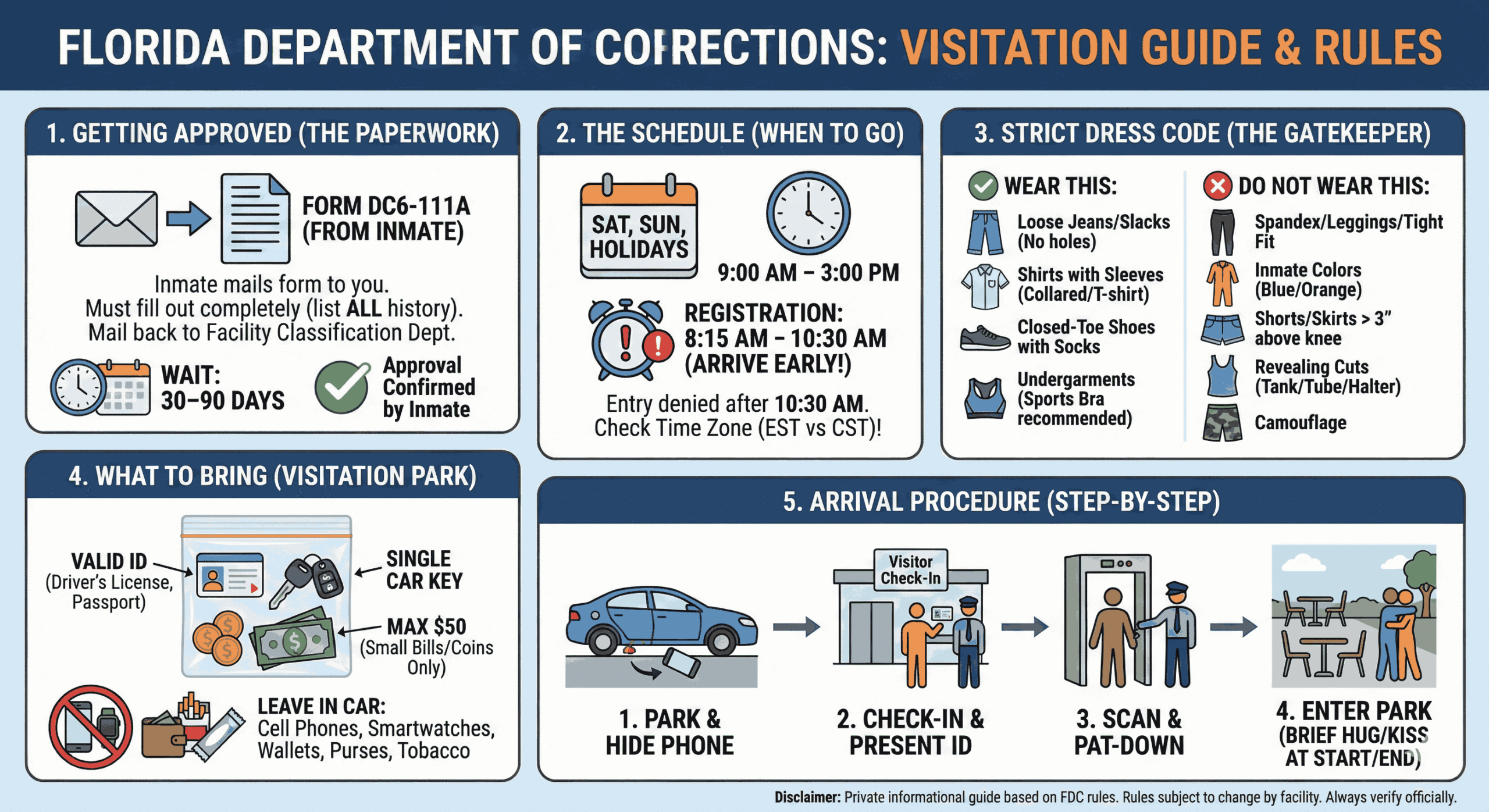
Florida’s statewide rules establish the visitation framework, while the institution controls day-to-day operations. Weekends and state-recognised holidays are common visitation periods, but admission windows, check-in cutoffs, session lengths and special schedules can differ or change.
| Check | Why it matters | What to do |
|---|---|---|
| Visiting date | A holiday, special operation or inmate status can alter the normal schedule. | Confirm the exact date with the institution. |
| Registration window | Facilities stop processing new arrivals before the visiting period ends. | Ask for the current opening and final registration time. |
| Time zone | Florida Panhandle facilities may operate on Central Time while most of the state uses Eastern Time. | Confirm the facility’s local time before calculating the trip. |
| Lockdown or security event | A visit can be delayed, restricted or cancelled with little notice. | Call before leaving and again when travelling a long distance. |
| Weather | Hurricanes, flooding, heat and road closures affect institutions and travel. | Review official emergency notices and local road conditions. |
| Inmate eligibility | Confinement, disciplinary status, medical movement or transfer can affect the visit. | Have the incarcerated person confirm current eligibility. |
Arrive early enough for parking, queueing, identification and security screening, but use the specific institution’s current registration instructions. A fixed arrival recommendation from an independent website cannot override a facility change.
Florida Prison Visitor Dress Code
Rule 33-601.724 addresses visitor attire. Staff evaluate the complete outfit, including fit, coverage, fabric, colour, footwear and resemblance to inmate or staff uniforms. The safest plan is conservative clothing with a backup outfit in the vehicle.
Lower-risk choices
- Loose-fitting trousers, jeans or a modest skirt.
- Opaque shirt with sleeves and a normal neckline.
- Clothing that fully covers the midriff and undergarments.
- Closed, secure footwear suitable for screening and walking.
- Simple layers without metal-heavy decoration.
- Colours and patterns that do not resemble institutional uniforms.
High-risk or prohibited choices
- Transparent, mesh or see-through clothing.
- Skin-tight leggings, spandex or body-hugging garments.
- Tank, halter, tube or strapless tops.
- Very short shorts, skirts or dresses.
- Clothing exposing the chest, back, stomach or undergarments.
- Camouflage, offensive graphics or clothing resembling inmate or officer uniforms.
A spare shirt, trousers and closed shoes can save the trip when staff reject one item. Changing one garment may not solve a problem created by the full outfit.
What Visitors Can Bring
Rule 33-601.725 covers permissible visitor items. The purpose is to keep the visiting area secure and reduce property that must be searched. Institution instructions can be more restrictive, so carry only what is necessary.
| Item | General preparation | Important limitation |
|---|---|---|
| Photo identification | Carry an unexpired government-issued photo ID. | A damaged, expired or mismatched ID can prevent entry. |
| Vehicle key | Carry only the key or fob needed to secure and reopen the vehicle. | Leave unnecessary keys, tools and attachments outside. |
| Vending money | Bring only the amount and denominations the facility permits, often in a clear container. | Confirm the current limit and whether machines accept bills, coins or a facility card. |
| Infant supplies | Use limited quantities and clear containers for approved bottles, diapers, wipes and related items. | Ask for the exact item and quantity list before travel. |
| Medication or medical device | Contact the facility in advance for medically necessary property. | Do not arrive with medication or equipment assuming it will be admitted automatically. |
| Accessibility item | Request advance instructions for mobility, hearing, communication or other accessibility needs. | Security screening still applies, but reasonable arrangements may require planning. |
Phones, smartwatches, recording devices, purses, backpacks, tobacco products, weapons, food, drinks and unauthorised papers or gifts should not be carried to the visitor-processing point unless the institution expressly authorises them.
What Happens at Visitor Check-In
- Secure unapproved propertyLock phones, bags, extra keys and other prohibited items in the vehicle before approaching visitor processing.
- Present identificationStaff compare the visitor’s identity with the approved list and review any required minor or guardianship documents.
- Confirm propertyPermitted cash, infant items, medical equipment and other approved property can be counted or inspected.
- Complete security screeningScreening can include metal detection, handheld scanning, pat search, visual inspection and other search methods authorised by Rule 33-601.726.
- Follow staff instructionsRefusing a lawful search or failing to follow instructions can result in denial or termination of the visit.
- Enter the assigned areaUse the seat, table or visiting position assigned by staff and keep children supervised.
- Check out correctlyAt the end of the visit, follow staff directions and do not leave with property that belongs to the incarcerated person or institution.
Conduct During the Visit
Rules 33-601.727 and 33-601.728 address visitor and inmate conduct. The visit remains supervised, and the warden or staff can restrict contact, seating, movement and activities for security or inmate-status reasons.
Physical contact
Only contact permitted by current rules and staff direction is allowed. Keep greetings and farewells brief and appropriate.
Assigned seating
Remain in the assigned place and do not rearrange furniture or move to another family’s area without permission.
No item exchange
Do not pass cash, notes, medication, jewellery, food brought from outside or any other unauthorised property.
Supervise children
The accompanying adult remains responsible for the child’s behaviour and compliance with visiting-area instructions.
Vending purchases
Use only the process permitted by the institution. The incarcerated person cannot possess visitor cash.
Follow directions immediately
Arguments, disruptive conduct, suspected contraband or repeated rule violations can end the visit and affect future privileges.
Non-Contact, Special and Restricted Visits
Non-contact visitation
Rule 33-601.735 covers visits where a barrier prevents physical contact. This can apply because of security classification, disciplinary history, contraband risk or another authorised reason. Confirm the format before travelling because seating, contact and vending access may differ.
Special visits
Rule 33-601.736 allows a separate process for circumstances outside normal visiting arrangements. Examples can involve a visitor travelling a significant distance, an unusual family circumstance, clergy or another approved purpose. Approval is discretionary and must be obtained before arrival.
Reception, medical or temporary status
People in reception, medical movement, temporary transfer or another special status may have limited or no regular visitation. Wait for current institutional confirmation.
Visits involving minors and restricted offenders
Rule 33-601.720 addresses restrictions involving inmates with certain sex-offense or child-abuse histories. Do not assume that ordinary approval authorises contact with a minor.
Video visitation
Remote video availability, provider, scheduling and fees can vary by institution and current contract. Video communication is separate from an in-person visit and does not automatically prove in-person approval. Confirm the service through the institution or FDC’s current communication information.
When a Visit Is Denied, Ended or Suspended
| Situation | Immediate result | Next step |
|---|---|---|
| Not on approved list | Entry is denied. | Confirm application status and the correct inmate record before returning. |
| Identification problem | Staff cannot complete check-in. | Replace or correct the ID and ask whether supporting documentation is needed. |
| Attire or property violation | Entry can be denied or delayed. | Use a compliant backup outfit or remove property only if staff allow reprocessing. |
| Refused search | Visit is denied. | Do not argue at the gate; obtain the official rule and complaint or review route if appropriate. |
| Conduct or contraband issue | Visit can end immediately and privileges may be suspended. | Read the written action and use Rules 33-601.731 and 33-601.732 for suspension and reinstatement. |
| Institutional cancellation | The visit can be delayed, shortened or cancelled. | Ask whether a later session or special-visit request is available; do not demand entry. |
Suspension periods, review dates and reinstatement requirements depend on the reason and current rule. Keep the notice and follow the process it identifies.
Florida Prison Visit Checklist
Several days before
- Confirmed visitor approval
- Verified current institution and DC number
- Recorded facility address and telephone
- Confirmed date, local time zone and registration window
- Asked about minor, medical or accessibility documents
- Reviewed current facility alerts
The night before
- Unexpired government photo ID packed
- Minor or guardianship documents packed
- Conservative primary outfit selected
- Complete backup outfit placed in vehicle
- Permitted cash or vending method prepared
- Unapproved property removed from visit bag
Before leaving home
- Called or checked the institution’s current status
- Reviewed weather and road conditions
- Allowed time for rural roads, parking and screening
- Confirmed Eastern or Central Time
- Stored the facility number offline
At the parking area
Secure the phone, smartwatch, wallet, purse, tobacco, food, drinks, gifts, papers and extra keys. Carry only the property the institution has authorised.
Recheck clothing before entering the processing line.
Florida Facility Lookup and Central Office Location
Florida Department of Corrections Central Office
501 South Calhoun Street, Tallahassee, Florida 32399-2500
Main telephone: 850-488-7052
Use the application’s official instructions and the incarcerated person’s current institution. The Tallahassee address is included for agency identification, not as a universal visitation-application destination.
Florida Department of Corrections Visitation FAQs
Is FloridaDepartmentOfCorrections.org an official state website?
No. It is an independent informational website. Official applications, approval decisions, offender records and institution instructions come from FDC and Florida government systems.
What form is used to request Florida prison visiting privileges?
The current Florida rule page identifies Form DC6-111A, Request for Visiting Privileges. Use the official current form and follow its submission instructions.
Can I download the Florida visitation application?
The official Florida Administrative Rules page provides a reference for DC6-111A, and the form can also be supplied through the incarcerated person or institution. Do not pay a private website for it.
How long does approval take?
There is no dependable universal promise. Screening time depends on the application, background review, institution and whether additional information is required. Do not travel until approval is confirmed.
Does a 12-year-old need a visitor application?
Visitors aged 12 or older are generally required to complete the application process. Confirm the current rule and identification documents with the institution.
Can a child under 12 visit?
A younger child can be subject to accompanying-adult, relationship, guardianship and security requirements. Ask the institution which documents to bring.
What should I disclose about criminal history?
Answer every question on the current form truthfully and completely. Do not omit information because a charge was old, dismissed or handled in another state when the form asks for it.
Can I visit before approval is complete?
No. Submission of the application does not authorise a visit. Confirm approval before travelling.
How do I confirm the inmate’s current prison?
Use FDC’s official Offender Information Search with the DC number or name, then confirm close to the visit because location information can change.
Are Florida prison visits held every weekend?
Weekends are common visiting periods, but an institution can restrict, delay or cancel visits because of security, operations, staffing, weather or inmate status. Confirm the current schedule.
What should I wear?
Choose loose, opaque, modest clothing with sleeves and secure shoes. Avoid tight, revealing, transparent, camouflage or uniform-like clothing, and carry a backup outfit.
Can I bring my phone?
Visitors should leave phones, smartwatches and other unauthorised electronic devices secured outside the visiting area unless the institution gives a specific exception.
Can I bring medication?
Contact the institution before travel for medically necessary medication or devices. Do not assume they can be carried into the visiting area without advance instructions.
What is a non-contact visit?
It is a supervised visit using a physical barrier that prevents direct contact. It may apply because of security, disciplinary or inmate-status reasons.
Can I request a special visit?
FDC rules provide a special-visit process for qualifying circumstances, but approval is discretionary and must be obtained before arrival.
What happens if visiting privileges are suspended?
Keep the written notice and follow the current suspension and reinstatement rules. The reason for suspension determines the review date and requirements.
Related Florida Corrections Guides
Rules and Official Sources Reviewed
This guide was rebuilt around the current Florida Administrative Code visitation sequence rather than relying on one unofficial checklist.
- Rule 33-601.713 — Inmate Visitation Definitions
- Rule 33-601.714 — Inmate Visiting General
- Rule 33-601.715 — Visitation Application Initiation Process
- Rules 33-601.716 through 33-601.718 — records, denial and review
- Rules 33-601.720 through 33-601.725 — restrictions, operations, on-site visits, check-in, attire and permissible items
- Rule 33-601.726 — Visitor Searches, effective 22 December 2024
- Rules 33-601.727 through 33-601.732 — conduct, termination, suspension and reinstatement
- Rules 33-601.735 and 33-601.736 — non-contact and special visits
- FDC Visiting Information, Institutions List and Offender Information Search